

-
1 system fault level
English-German dictionary of Electrical Engineering and Electronics > system fault level
-
2 масляный трансформатор
масляный трансформатор
Трансформатор с жидким диэлектриком, в котором основной изолирующей средой и теплоносителем служит трансформаторное масло
[ ГОСТ 16110-82]
масляный трансформатор
Трансформатор, магнитная система и обмотки которого погружены в масло
(МЭС 421-01-14)
[ ГОСТ 30830-2002]EN
oil-immersed type transformer
a transformer of which the magnetic circuit and windings are immersed in oi
[IEV number 421-01-14]FR
transformateur immergé dans l'huile
transformateur dont le circuit magnétique et les enroulements sont immergés dans l'huile
[IEV number 421-01-14]Oil transformers
The magnetic circuit and the windings are immersed in a liquid dielectric that provides insulation and evacuates the heat losses of the transformer.
This liquid expands according to the load and the ambient temperature. PCBs and TCBs are now prohibited and mineral oil is generally used. It is flammable and requires protective measures against the risks of fire, explosion and pollution.
The most commonly used protective measures are the DGPT or the DGPT2: Gas, Pressure and Temperature sensor with 1 or 2 sensing levels on the temperature. This system cuts off the LV load (1st level) then the HV supply (2nd level) when there is a fault inside the transformer. A holding tank is used to recover all the liquid dielectric.
Of the four types of immersed transformer: free breathing transformers, gas cushion transformers, transformers with expansion tank and transformers with integral filling, only the latter are currently installed.
[Legrand]Масляные трансформаторы
Магнитная система и обмотки трансформатора погружены в жидкий диэлектрик, служащий изоляцией и теплоносителем.
Жидкий диэлектрик изменяет свой объем в соответствии с нагрузкой трансформатора и температурой окружающей среды. Поскольку в настоящее время применение полихлорированных дифенилов и тетрахлорбифенилов запрещено, то в основном используют минеральное масло. Оно огнеопасно, поэтому необходимо принимать меры против возникновения пожара, взрыва и загрязнения окружающей среды.
Как правило, применяются системы DGPT (одноуровневые системы, использующие датчики газа, давления и температуры) или DGPT2 – двухуровневые системы. В случае возникновения аномального состояния трансформатора данные системы отключают нагрузку цепей низшего напряжения (первый уровень защиты), а затем питание обмотки высшего напряжения (второй уровень защиты). Активная часть трансформатора находится в баке и полностью покрыта жидким диэлектриком.
Существует четыре типа масляных трансформаторов: трансформаторы с системой свободного дыхания, трансформаторы с газовой подушкой между зеркалом масла и крышкой трансформатора, трансформаторы с расширительным баком и трансформаторы с гофрированным баком. В настоящее время применяют только трансформаторы последнего типа
[Интент]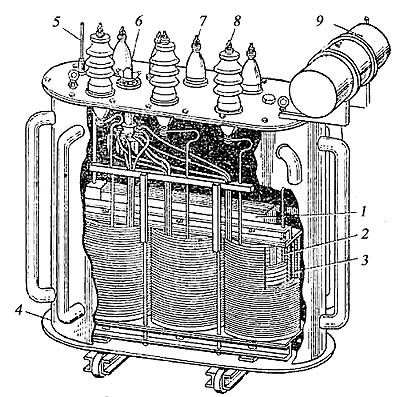
[http://www.ramo-chelny.ru/konschasti.html]Масляный трансформатор:
- Шихтованный магнитопровод
- Обмотка низшего напряжения
- Обмотка высшего напряжения
- Трубчатый бак
- Термометр
- Переключатель регулировочных отводов обмотки высшего напряжения
- Ввод (проходной изолятор) обмотки низшего напряжения
- Ввод (проходной изолятор) обмотки высшего напряжения
- Расширительный бак
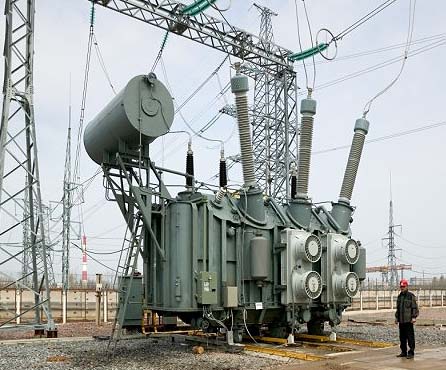
[http://transfcomplect.narod.ru/transformator.html]Тематики
Классификация
>>>EN
DE
FR
Русско-немецкий словарь нормативно-технической терминологии > масляный трансформатор
См. также в других словарях:
System Fault Tolerance — (SFT) is a fault tolerant system built into Netware operating systems. It is a disk mirroring system similar to RAID 1. SFT level III is a server duplexing system where if a server fails a mirrored server is ready to take its place … Wikipedia
System Fault Tolerance — Abbreviated SFT. In Novell NetWare, a method of duplicating data on several hard disks so that if one disk fails, the data is still available from another disk. Several levels of hardware and software SFT are available in NetWare, with each … Dictionary of networking
Fault — may refer to:*Fault (geology), planar rock fractures which show evidence of relative movement *Fault (technology), an abnormal condition or defect at the component, equipment, or sub system level which may lead to a failure *An asymmetric fault… … Wikipedia
Fault-tolerant design — In engineering, Fault tolerant design, also known as fail safe design, is a design that enables a system to continue operation, possibly at a reduced level (also known as graceful degradation), rather than failing completely, when some part of… … Wikipedia
Fault-tolerant system — This article contains specific implementations of fault tolerant systems. For general theory, see fault tolerant design. Fault tolerance or graceful degradation is the property that enables a system (often computer based) to continue operating… … Wikipedia
fault tolerance — A design method that ensures continued system operation in the event of individual failures by providing redundant elements. At the component level, the design includes redundant chips and circuits and the capability to bypass faults… … Dictionary of networking
Fault-tolerant computer systems — are systems designed around the concepts of fault tolerance. In essence, they have to be able to keep working to a level of satisfaction in the presence of faults. Types of fault tolerance Most fault tolerant computer systems are designed to be… … Wikipedia
Fault tree analysis — (FTA) is a failure analysis in which an undesired state of a system is analyzed using boolean logic to combine a series of lower level events. This analysis method is mainly used in the field of safety engineering to quantitatively determine the… … Wikipedia
Fault coverage — refers to the percentage of some type of fault that can be detected during the test of an electronic system, usually an integrated circuit. High fault coverage is particularly valuable during manufacturing test, and techniques such as Design For… … Wikipedia
Fault injection — In software testing, fault injection is a technique for improving the coverage of a test by introducing faults in order to test code paths, in particular error handling code paths, that might otherwise rarely be followed. It is often used with… … Wikipedia
Fault (technology) — In document ISO/CD 10303 226, a fault is defined as an abnormal condition or defect at the component, equipment, or sub system level which may lead to a failure. According to the Federal Standard 1037C of the United States, the term fault has the … Wikipedia
